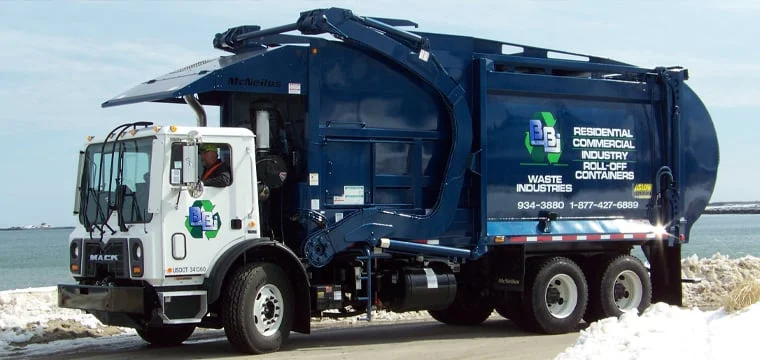

If you’re buying or spec’ing a refuse collection vehicle, the first decision you’ll face isn’t which brand to choose. It’s which body type fits your operation.
Rear loaders, side loaders, and front loaders each have a job they were built to do. Match the right body to your routes and you’ll run a faster, leaner, lower-cost operation. Get it wrong and you’ll spend the life of that truck working around it.
Here’s a straightforward breakdown of all three body types, where each performs best, and how to make the right call for your fleet.
Rear Loader Garbage Trucks
How They Work
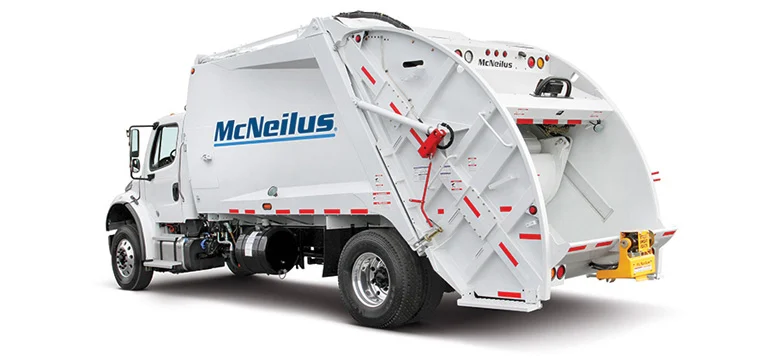
Rear loaders are exactly what the name suggests: collection happens at the back of the truck. A crew loads waste manually through the rear opening, and a compaction blade pushes material forward into the hopper. Depending on the model, rear loaders are available in standard, heavy-duty, extra compaction, tag axle, and split body configurations.
Where Rear Loaders Excel
Rear loaders are the most versatile body type in refuse collection. They are not tied to a specific container format, which means they can handle bags, bins, bulk items, brush, and anything else a resident or business sets out at the curb. That flexibility makes them a strong fit for mixed routes, older neighborhoods without standardized carts, and any operation that collects varying waste types in a single pass.
The McNeilus Split Body rear loader takes this a step further by dividing the hopper into two compartments, allowing simultaneous collection of refuse and recyclables on the same route without a second truck.
Rear loaders are the right choice when:
- Routes mix residential, bulk, and brush collection
- Cart standardization is not in place
- The operation requires split-stream collection (refuse plus recycling in one pass)
- Rural or lower-density routes make automation less efficient
- Manual crew flexibility is a priority
The Trade-off
Rear loaders require at least one loader in addition to the driver, which means higher labor cost per route. On dense residential routes with standardized carts, an automated side loader will almost always run faster and cheaper.
Side Loader Garbage Trucks
How They Work
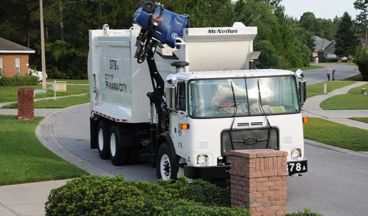
Side loaders collect from the side of the truck using either a manual process or an automated arm. Automated side loaders (ASL), like the McNeilus AutoReach series, use a mechanical arm to lift and tip carts without the driver leaving the cab. The Volterra ZSL takes this further as a fully electric, zero-emission automated side loader built for fleets operating under strict emissions requirements.
Where Side Loaders Excel
Side loaders own residential collection. On cart-based routes with consistent container placement, an automated side loader can complete a full residential route with a single operator, dramatically reducing labor cost versus a rear loader crew. The McNeilus AutoReach arm extends in an 8-foot arc and lifts up to 2,000 pounds, handling most residential carts efficiently even when parked cars or obstacles are nearby.
For California and Arizona fleets facing CARB Advanced Clean Fleets requirements, the Volterra ZSL is the purpose-built answer: a fully integrated electric side loader that meets zero-emission mandates without sacrificing collection performance.
Side loaders are the right choice when:
- Routes are residential with standardized cart service
- Labor reduction is a budget priority
- One-person operation is the goal
- The fleet operates in a regulated air district or under zero-emission mandates
- Route density and consistency make automation efficient
The Trade-off
Automated side loaders depend on consistent cart placement. They are not well-suited for bulk pickup, commercial dumpsters, or routes with highly variable container types. Manual override is always an option, but the efficiency advantage narrows quickly on mixed or unpredictable routes.
Front Loader Garbage Trucks
How They Work
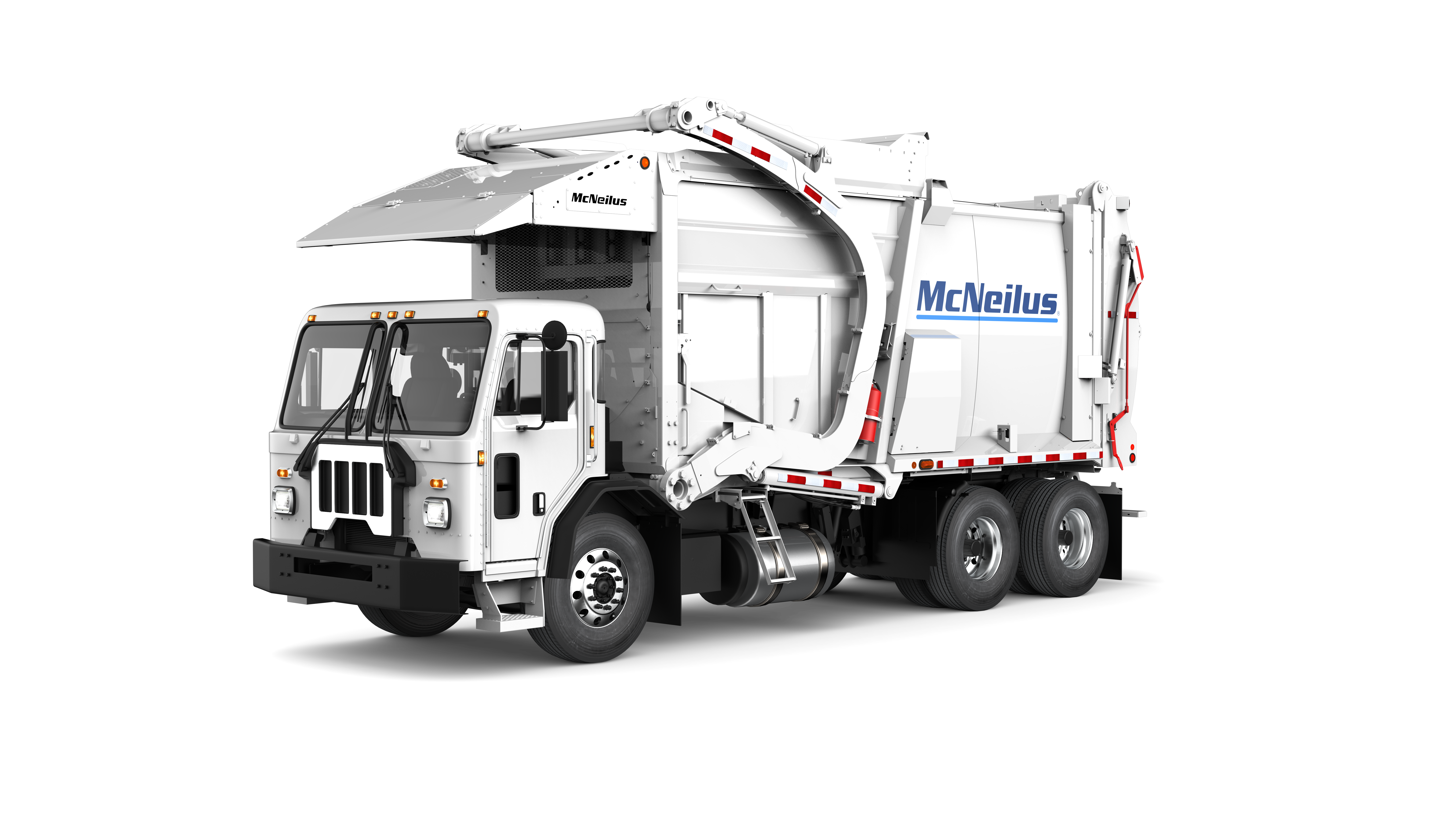
Front loaders use two large forks at the front of the truck to lift commercial containers, dumpsters, and large bins overhead and empty them directly into the hopper. The McNeilus front loader lineup includes the Atlantic, Meridian, and the Volterra ZFL electric model. These are single-operator trucks built for speed and volume on commercial routes.
Where Front Loaders Excel
Front loaders are purpose-built for commercial and industrial collection. They handle 2-yard to 8-yard dumpsters quickly and efficiently, making them the right tool for restaurant districts, shopping centers, office parks, industrial facilities, and multi-family housing complexes with shared containers. A single operator can complete a high-volume commercial route in far less time than any rear loader crew could manage with the same stops.
Front loaders are the right choice when:
- Routes are commercial or industrial with large dumpsters
- High container volume per stop is the norm
- Single-operator efficiency is a priority
- Multi-family housing or commercial districts are the primary service area
The Trade-off
Front loaders are not suited for residential collection. They require compatible containers with standardized pocket widths, which means they only work where that infrastructure is already in place.
Side-by-Side Comparison
| Factor | Rear Loader | Side Loader | Front Loader |
|---|---|---|---|
| Best route type | Mixed residential, bulk, brush | Residential with standardized carts | Commercial and industrial |
| Container type | Any | Standard carts (automated) | Commercial dumpsters (2-8 yd) |
| Crew required | Driver plus 1+ loaders | Single operator (ASL) | Single operator |
| Labor cost | Higher | Lower (automated) | Lower |
| Electric option | No | Yes (Volterra ZSL) | Yes (Volterra ZFL) |
| Best for CA/AZ compliance | Standard | Volterra ZSL | Volterra ZFL |
| Split-stream collection | Yes (Split Body) | No | No |
How to Choose: Three Questions to Start With
1. What type of routes are you running?
Residential cart routes point toward a side loader. Commercial dumpster routes point toward a front loader. Mixed routes, bulk pickup, or non-standardized service point toward a rear loader.
2. What is your labor model?
If reducing crew size is a priority, automated side loaders and front loaders both deliver single-operator efficiency. If your operation already runs multi-person crews and needs maximum flexibility, rear loaders give you the most versatility per truck.
3. What are your compliance requirements?
If you operate in California or Arizona under CARB Advanced Clean Fleets mandates or local air quality rules, your decision needs to account for zero-emission requirements now, not later. The McNeilus Volterra ZSL and Volterra ZFL are built for exactly this transition.
Talk to the Experts at Haaker Refuse Before You Spec
Haaker Refuse carries the full McNeilus lineup across all three body types, including rear loaders, side loaders, the AutoReach automated series, and the Volterra electric models. Our team has helped municipalities and haulers across California and Arizona make these spec decisions for decades, and we understand the route conditions, regulatory landscape, and operational realities of this region better than anyone.
We’re not here to sell you the most truck. We’re here to make sure you get the right one.
View the McNeilus Lineup | Contact Our Team
Frequently Asked Questions
What is the difference between a rear loader and a side loader garbage truck?
A rear loader collects waste from the back of the truck through manual loading by a crew, making it highly versatile for mixed routes and non-standardized containers. A side loader collects from the side using either a manual process or an automated arm, and is optimized for residential routes with standardized carts, often as a one-person operation.
Which garbage truck is best for residential collection routes?
Automated side loaders are typically the best fit for residential routes with standardized cart service. The McNeilus AutoReach and the Volterra ZSL deliver single-operator efficiency and fast cycle times on consistent residential routes. For routes without standardized carts or with bulk and brush pickup, a rear loader offers more flexibility.
Which refuse truck is best for commercial collection?
Front loaders are purpose-built for commercial routes. They lift and empty large dumpsters quickly with a single operator, making them the most efficient choice for restaurants, shopping centers, office parks, and industrial facilities with 2-yard to 8-yard containers.
Can a side loader handle both residential and commercial collection?
Side loaders are optimized for residential cart collection. They are not designed to handle commercial dumpsters. Operations that run both residential and commercial routes typically spec separate body types, or use a rear loader on mixed routes where flexibility matters more than single-route efficiency.
Are electric refuse trucks available for all three body types?
Yes. McNeilus offers the Volterra ZSL (electric automated side loader) and the Volterra ZFL (electric front loader). These models are purpose-built for fleets operating under zero-emission mandates in California and Arizona. Contact Haaker Refuse to discuss availability and lead times for your region.
Haaker Refuse serves municipalities and waste haulers across California and Arizona with the full McNeilus refuse truck lineup. Nobody works harder for you.